# UC02

**CD --> SFG --> AMF --> SFG --> SFTP**&#x20;

**Use Case:** Partner03 (Sender) send files to SFG via CD protocol, we change the file name and deliver those files to the Partner04 (Receiver) using SFTP protocol from SFG via AMF (Agile Messaging Framework).

**Sequence Diagram:**

<figure><img src="https://529847091-files.gitbook.io/~/files/v0/b/gitbook-x-prod.appspot.com/o/spaces%2F3lEcft4Hj193xOMx83Gm%2Fuploads%2FeYTTxagspSlMTiyCm8xk%2FUC02.drawio.png?alt=media&#x26;token=895d96f8-1fef-40e2-8001-87653415dc9a" alt=""><figcaption></figcaption></figure>

**Steps:**&#x20;

A. Onboard Partner03 and Partner04 in SFG using AMF.&#x20;

B. Onboard Partner03 connect direct node in SFG using AMF (CD Customer Initiated Communication Profile (Inbound)).&#x20;

C. Create Message Type or use the existing one in AMF.&#x20;

D. Create Message Mapping with Sender, Receiver and Message Type with a file pattern.

E. Create **Route** Action with file name format.

F. Create Delivery Action or use the predefined one (Deliver as is).

G. Create Workflow Definition and add Actions (Created in **step F** and **step G**) as step1 and step2.

H. Create Workflow Rule with Sender, Receiver, Message Type and Workflow Definition Name (Created in **step H**).&#x20;

I. Create MFT Initiated Send Communication Profile for outbound delivery in Partner04 with SFTP protocol.&#x20;

J. Create Communication Rule with Sender, Receiver, Message Type and Comm Profile Name.

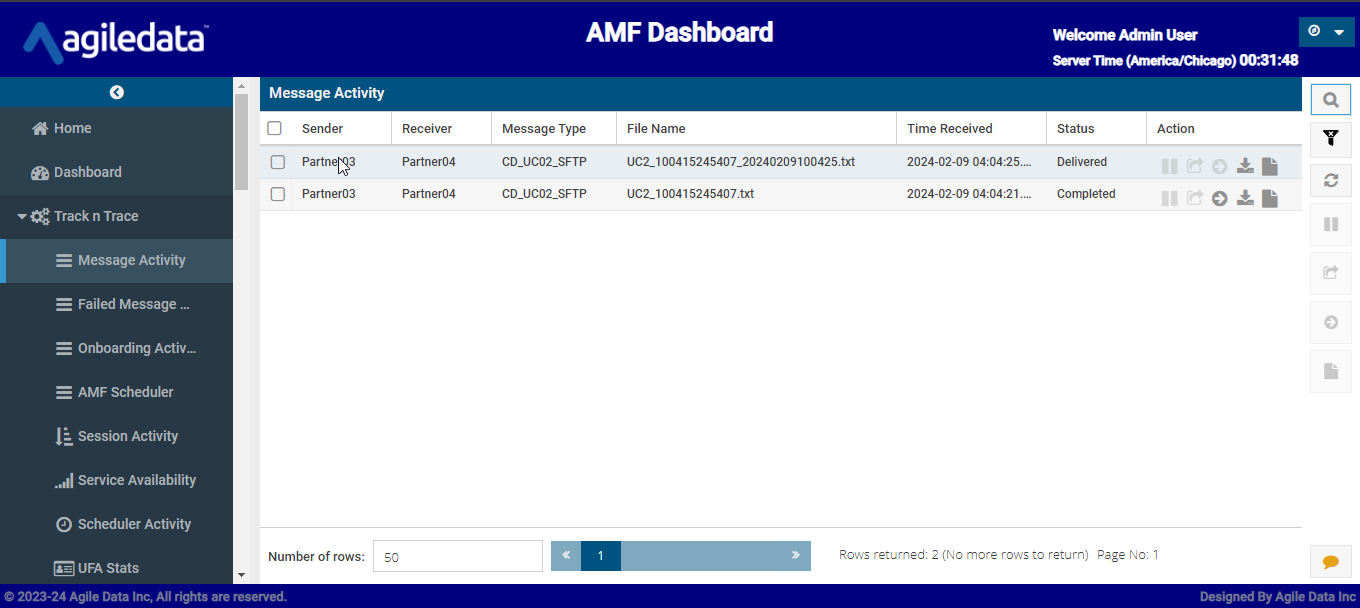
K. Verify the Message activity in AMF once the Partner03 uploads the file to SFG via CD protocol. If everything was configured correctly, the file will be delivered to Partner04 via SFTP protocol.&#x20;

**Process:**

**A. Onboard Partner03 and Partner04 in SFG via AMF:**

Login to AMF

![](https://529847091-files.gitbook.io/~/files/v0/b/gitbook-x-prod.appspot.com/o/spaces%2F3lEcft4Hj193xOMx83Gm%2Fuploads%2FmnmBM3D6B7ATEYSOq3YS%2F0?alt=media)

Go to Onboarding -> Users.

<figure><img src="https://529847091-files.gitbook.io/~/files/v0/b/gitbook-x-prod.appspot.com/o/spaces%2F3lEcft4Hj193xOMx83Gm%2Fuploads%2FVoF0EDL8gy8boSM1KmG5%2F1.png?alt=media&#x26;token=dcf762d0-81c9-4195-af9e-c68096b5df0e" alt=""><figcaption></figcaption></figure>

Click on + icon at the top right corner

<figure><img src="https://529847091-files.gitbook.io/~/files/v0/b/gitbook-x-prod.appspot.com/o/spaces%2F3lEcft4Hj193xOMx83Gm%2Fuploads%2FSyM6US5MVpHpHHc8bHmn%2F2.png?alt=media&#x26;token=9ad8c671-86f0-4da2-a269-e1a654a8fc46" alt=""><figcaption></figcaption></figure>

Select Customer and give details of Partner03, select User Type, Authentication Type and click next.

1. **User Type**: Which Zone does the Partner belongs to send or receive files? (DMZ or Trusted)
2. **Authentication Type**: Where do we store the Partner credentials? (LDAP or local (SFG/AMF) or Both)

<figure><img src="https://529847091-files.gitbook.io/~/files/v0/b/gitbook-x-prod.appspot.com/o/spaces%2F3lEcft4Hj193xOMx83Gm%2Fuploads%2FOg74oWMlcmqqORXIuzeX%2F3.png?alt=media&#x26;token=d0d25961-baee-4843-818d-a552c8d854d5" alt=""><figcaption></figcaption></figure>

Select the provider the Partner belongs to and click next

1. **AMF:** AMF provider is used to onboard Partners which use UFA
2. **IBM:** This will come from the provider's config. We can choose several types based on the provider's config.
3. **Open Ldap:** We need to select this if we selected the Authentication Type as LDAP in step 2

<figure><img src="https://529847091-files.gitbook.io/~/files/v0/b/gitbook-x-prod.appspot.com/o/spaces%2F3lEcft4Hj193xOMx83Gm%2Fuploads%2FXJy7gRwBhhwEw5Wi0Alw%2F4.png?alt=media&#x26;token=a6ad8cff-7c98-4244-bad3-a9cc13338a57" alt=""><figcaption></figcaption></figure>

<figure><img src="https://529847091-files.gitbook.io/~/files/v0/b/gitbook-x-prod.appspot.com/o/spaces%2F3lEcft4Hj193xOMx83Gm%2Fuploads%2FXfaDPe1Z4q2RO20KWxek%2F5.png?alt=media&#x26;token=285f9e1d-fd42-4579-9102-facd81fc3cfb" alt=""><figcaption></figcaption></figure>

Verify the Partner details and click **Onboard User**.

Repeat the above steps for Partner04.

**B. Onboard Partner03 connect direct node in SFG using AMF (Customer Initiated communication profile (Inbound)).**

Double click on the Partner03

<figure><img src="https://529847091-files.gitbook.io/~/files/v0/b/gitbook-x-prod.appspot.com/o/spaces%2F3lEcft4Hj193xOMx83Gm%2Fuploads%2FuV1paIppJktTnQShr3sz%2F6.png?alt=media&#x26;token=cf423fa3-da3b-4277-b028-cb76a03b7f3e" alt=""><figcaption></figcaption></figure>

Click on + icon in the top right corner

<figure><img src="https://529847091-files.gitbook.io/~/files/v0/b/gitbook-x-prod.appspot.com/o/spaces%2F3lEcft4Hj193xOMx83Gm%2Fuploads%2Ft59iYrWVVdGdQ2bVbQOW%2F7.png?alt=media&#x26;token=06819644-f529-480d-89c0-97394b118252" alt=""><figcaption></figcaption></figure>

Give details of the Node and click save

<figure><img src="https://529847091-files.gitbook.io/~/files/v0/b/gitbook-x-prod.appspot.com/o/spaces%2F3lEcft4Hj193xOMx83Gm%2Fuploads%2FVjgtN90GvuZdCrDxU50e%2F8.png?alt=media&#x26;token=abed0295-0274-448f-b77b-38636d8bd781" alt=""><figcaption></figcaption></figure>

1. **Operating System:** Operating system of the Partner03
2. **SPOE:** Option to enable/disable Secure point of entry
3. **Node Name:** Node name of Parnter03
4. **Host Name/IP:** Host/Ip of the Partner03 CD node
5. **Port:** Port of the Partner03 CD node
6. **Alternate Ips:** we can give there are any alternate IPs for this CD node
7. **Secure+:** Option to enable/disable secure+ for SSL
8. **Cert File:** Public cert of the Partner03 CD node (In txt format with no headers)
9. **Common Name:** Common name of the Partner03 CD certificate
10. **TLS Version:** TLS version to be used in the communication
11. **Ciphers:** Ciphers to be used in the communication.

Once the onboarding was done, we can see the status as completed.

<figure><img src="https://529847091-files.gitbook.io/~/files/v0/b/gitbook-x-prod.appspot.com/o/spaces%2F3lEcft4Hj193xOMx83Gm%2Fuploads%2FjtntCnd6b78I6fOCyG51%2F9.png?alt=media&#x26;token=e4dc30ff-c692-4f4d-8856-97a6e22bc805" alt=""><figcaption></figcaption></figure>

**C. Create Message Type or use the existing one in AMF:**

Go to Message Type under Onboarding

<figure><img src="https://529847091-files.gitbook.io/~/files/v0/b/gitbook-x-prod.appspot.com/o/spaces%2F3lEcft4Hj193xOMx83Gm%2Fuploads%2FR2SpjvEIMK0PZHS35dtB%2F10.png?alt=media&#x26;token=a113f276-d2d7-48c7-b1d9-d97989b327ca" alt=""><figcaption></figcaption></figure>

Click on + icon in the right corner to add a new Message Type

<figure><img src="https://529847091-files.gitbook.io/~/files/v0/b/gitbook-x-prod.appspot.com/o/spaces%2F3lEcft4Hj193xOMx83Gm%2Fuploads%2F6wDBueF4sc4ds23W5OgM%2F11.png?alt=media&#x26;token=f746256f-5f6d-4d5f-aa11-f3017b734956" alt=""><figcaption></figcaption></figure>

Give a proper name to Message Type and Description and then click save

<figure><img src="https://529847091-files.gitbook.io/~/files/v0/b/gitbook-x-prod.appspot.com/o/spaces%2F3lEcft4Hj193xOMx83Gm%2Fuploads%2FcqjfBbfgTFjQ0wTjguIC%2F12.png?alt=media&#x26;token=dd5577d5-c86b-4b42-9823-d284e646a339" alt=""><figcaption></figcaption></figure>

**Note**: In this scenario we will use the existing Message Type (GENERIC)

**D. Create Message Mapping with Sender, Receiver and Message Type with a file pattern:**

Go to Message Mapping under Onboarding

<figure><img src="https://529847091-files.gitbook.io/~/files/v0/b/gitbook-x-prod.appspot.com/o/spaces%2F3lEcft4Hj193xOMx83Gm%2Fuploads%2FvZk91neCAlM9L6gzNG64%2F13.png?alt=media&#x26;token=4eb71c7d-85a4-4d05-9183-659e89b2d9ae" alt=""><figcaption></figcaption></figure>

Click on +icon at the top right corner

<figure><img src="https://529847091-files.gitbook.io/~/files/v0/b/gitbook-x-prod.appspot.com/o/spaces%2F3lEcft4Hj193xOMx83Gm%2Fuploads%2FGhcJYsUhOTUpCNgqTanC%2F14.png?alt=media&#x26;token=b276b0d5-4589-433a-b246-4a8634457bf3" alt=""><figcaption></figcaption></figure>

Select Sender, Receiver and Message Type give pattern of the files that Partner03 will send and click save.

<figure><img src="https://529847091-files.gitbook.io/~/files/v0/b/gitbook-x-prod.appspot.com/o/spaces%2F3lEcft4Hj193xOMx83Gm%2Fuploads%2FwhtF5ScSvB3jTxR9op0a%2F15.png?alt=media&#x26;token=38044113-7f85-4db0-bba0-e33bc3cbfc5e" alt=""><figcaption></figcaption></figure>

**E.  Create Route Action with adding file name format.**

Go to Actions under Onboarding->Workflow

<figure><img src="https://529847091-files.gitbook.io/~/files/v0/b/gitbook-x-prod.appspot.com/o/spaces%2F3lEcft4Hj193xOMx83Gm%2Fuploads%2Fz6ZfIPAfcIFvcshzyf5L%2F16.png?alt=media&#x26;token=8ea4eba4-f4e1-49c5-ba1e-b463ffcb0529" alt=""><figcaption></figcaption></figure>

Click on + icon to create new action

<figure><img src="https://529847091-files.gitbook.io/~/files/v0/b/gitbook-x-prod.appspot.com/o/spaces%2F3lEcft4Hj193xOMx83Gm%2Fuploads%2FkNc3EpiNWtS0NkRi0dN6%2F17.png?alt=media&#x26;token=a2e6f0df-3e50-405c-908a-cf410b0552c1" alt=""><figcaption></figcaption></figure>

Give Name, select Route as Action Type, and in the file name format give the required file name format using tokens

<figure><img src="https://529847091-files.gitbook.io/~/files/v0/b/gitbook-x-prod.appspot.com/o/spaces%2F3lEcft4Hj193xOMx83Gm%2Fuploads%2FeIWVHwSzT8QuNC9ZrDmG%2F18.png?alt=media&#x26;token=1b379e6f-19d6-4031-af68-908a47f96c4e" alt=""><figcaption></figcaption></figure>

**F**. **Create Delivery Action or use the predefined one (Deliver as is):**

Go to Actions under Onboarding->Workflow

<figure><img src="https://529847091-files.gitbook.io/~/files/v0/b/gitbook-x-prod.appspot.com/o/spaces%2F3lEcft4Hj193xOMx83Gm%2Fuploads%2Fw9FlCOUaRn7FGWuZUZx5%2F19.png?alt=media&#x26;token=bcff97da-3359-4284-9251-ffb85e972223" alt=""><figcaption></figcaption></figure>

&#x20;     Click on + icon to create new action

<figure><img src="https://529847091-files.gitbook.io/~/files/v0/b/gitbook-x-prod.appspot.com/o/spaces%2F3lEcft4Hj193xOMx83Gm%2Fuploads%2F0VmjjAymphEa2hhnBpYw%2F20.png?alt=media&#x26;token=3fa2e342-fa12-4c4b-b417-43e1fcef0184" alt=""><figcaption></figcaption></figure>

**Note**: In this scenario we will use the existing Action (Deliver as is)

**H. Create Workflow Definition and add Actions (Created in step F and step G) as step1 and step2.**

Go to Definitions under Onboarding->Workflow

<figure><img src="https://529847091-files.gitbook.io/~/files/v0/b/gitbook-x-prod.appspot.com/o/spaces%2F3lEcft4Hj193xOMx83Gm%2Fuploads%2FY2ccYahvFfmACfdfkwJM%2F21.png?alt=media&#x26;token=51735690-eb6c-4e5d-9f74-2492a4a971e6" alt=""><figcaption></figcaption></figure>

Click on + icon at the top right corner.

<figure><img src="https://529847091-files.gitbook.io/~/files/v0/b/gitbook-x-prod.appspot.com/o/spaces%2F3lEcft4Hj193xOMx83Gm%2Fuploads%2FFzqMuyalgzYJzYz7n4T5%2F22.png?alt=media&#x26;token=1e66c2b8-93e1-4502-bca9-9a9d03d78723" alt=""><figcaption></figcaption></figure>

Give Workflow Name, Description and click save.

<figure><img src="https://529847091-files.gitbook.io/~/files/v0/b/gitbook-x-prod.appspot.com/o/spaces%2F3lEcft4Hj193xOMx83Gm%2Fuploads%2F6JQ5UQjo81zqVy2JThuC%2F23.png?alt=media&#x26;token=5ab92d2d-b9b4-4935-8507-8c955f9fb8b5" alt=""><figcaption></figcaption></figure>

Double click on the Workflow Definition Name

<figure><img src="https://529847091-files.gitbook.io/~/files/v0/b/gitbook-x-prod.appspot.com/o/spaces%2F3lEcft4Hj193xOMx83Gm%2Fuploads%2FNcenDKfflIY3V3jC304L%2F24.png?alt=media&#x26;token=d97eac09-9d06-494c-a07e-52aee3d5ae58" alt=""><figcaption></figcaption></figure>

Click on the + icon at the top right corner

<figure><img src="https://529847091-files.gitbook.io/~/files/v0/b/gitbook-x-prod.appspot.com/o/spaces%2F3lEcft4Hj193xOMx83Gm%2Fuploads%2FCWNTitpmSzuxjNupBVNq%2F25.png?alt=media&#x26;token=46abe9bb-3315-4f63-849f-7a2dce8db756" alt=""><figcaption></figcaption></figure>

Select the action that we created in **step F** step1 and click save.

<figure><img src="https://529847091-files.gitbook.io/~/files/v0/b/gitbook-x-prod.appspot.com/o/spaces%2F3lEcft4Hj193xOMx83Gm%2Fuploads%2FXmqkUYkI9vRtfoDWYO8l%2F26.png?alt=media&#x26;token=2e9df257-b5bc-4066-9a03-fdc951e4dc1e" alt=""><figcaption></figcaption></figure>

Select the action that we created in **step G** step 2 and click save.

<figure><img src="https://529847091-files.gitbook.io/~/files/v0/b/gitbook-x-prod.appspot.com/o/spaces%2F3lEcft4Hj193xOMx83Gm%2Fuploads%2FWJAwHc8bBD8WgMKrft3b%2F27.png?alt=media&#x26;token=1721590e-d256-45f6-9b31-9f4e8cac1521" alt=""><figcaption></figcaption></figure>

<figure><img src="https://529847091-files.gitbook.io/~/files/v0/b/gitbook-x-prod.appspot.com/o/spaces%2F3lEcft4Hj193xOMx83Gm%2Fuploads%2FVmG2RfHA1DDwpCxInoHo%2F28.png?alt=media&#x26;token=eedb453a-7163-469b-8d31-dbd6e86389c0" alt=""><figcaption></figcaption></figure>

**I. Create Workflow Rule with Sender, Receiver, Message Type and Workflow Definition Name (Created in step H).**&#x20;

Go to Rules under Onboarding -> Workflow

<figure><img src="https://529847091-files.gitbook.io/~/files/v0/b/gitbook-x-prod.appspot.com/o/spaces%2F3lEcft4Hj193xOMx83Gm%2Fuploads%2FvcWmFh7O9Mr6dXiJjJOw%2F29.png?alt=media&#x26;token=c9f62a92-cacf-41ef-9a3e-360dcb122c2f" alt=""><figcaption></figcaption></figure>

Click on + icon at the top right

<figure><img src="https://529847091-files.gitbook.io/~/files/v0/b/gitbook-x-prod.appspot.com/o/spaces%2F3lEcft4Hj193xOMx83Gm%2Fuploads%2FnRunzPQosJ70JeziHmgq%2F30.png?alt=media&#x26;token=81c81288-da79-4ed0-8b68-d4ca5d23a615" alt=""><figcaption></figcaption></figure>

Give Sender, Receiver, Message Type and Workflow (Created in **step H**) and click on save

<figure><img src="https://529847091-files.gitbook.io/~/files/v0/b/gitbook-x-prod.appspot.com/o/spaces%2F3lEcft4Hj193xOMx83Gm%2Fuploads%2FcBoqSF1nXQ0UCF1pjGeT%2F31.png?alt=media&#x26;token=a532db29-8f2c-4df7-8a94-7d54834b5fb4" alt=""><figcaption></figcaption></figure>

**J. Create MFT Initiated Send Communication Profile for outbound delivery in Partner04 with SFTP protocol.**

Double click on Partner04 in Onboarding-> users

<figure><img src="https://529847091-files.gitbook.io/~/files/v0/b/gitbook-x-prod.appspot.com/o/spaces%2F3lEcft4Hj193xOMx83Gm%2Fuploads%2FS69cTQ9BR7FDTg9LYNdB%2F32.png?alt=media&#x26;token=f1a1ee69-0c0d-426a-858c-2a411b4bb75d" alt=""><figcaption></figcaption></figure>

Click on + icon at the top right

<figure><img src="https://529847091-files.gitbook.io/~/files/v0/b/gitbook-x-prod.appspot.com/o/spaces%2F3lEcft4Hj193xOMx83Gm%2Fuploads%2FNmvhDd8Tx2Q60LM9EYAG%2F33.png?alt=media&#x26;token=636aea9d-3cb9-4d47-88db-4dcea5719294" alt=""><figcaption></figcaption></figure>

Select MFT initiated Send and give the details (SFTP Protocol)

1. **Remote Host:** Remote Host/IP of the Partner04 SFTP server
2. **Remote Port:** Port of the Partner04 SFTP server
3. **Remote User ID:** Remote User ID of Partner04 in the SFTP server
4. **Auth Type:** Auth type supported by Remote SFTP server (password or key)
5. **Use Source File Name:** Option to use source filename
6. **Remote File Name:** Remote file name if you disabled the **Use Source File Name** in the 3-v
7. **Remote Path:** Path for the file to be placed
8. **Use Temp File Name in Copy:** Option to use temp file name in copy
9. **Remote KHK (Known Host Key):** Known host key of Remote SFTP server
10. **Send Email Notifications:** Option to send email notifications for successful delivery
11. **Receiver’s Mail Ids:** Recipients mail addresses if we enable **Send Email Notifications**.
12. **Clean up on delivery:** Option to clean the file in file system after the file was delivered (Once the file is cleaned, we cannot redeliver the file again)

<figure><img src="https://529847091-files.gitbook.io/~/files/v0/b/gitbook-x-prod.appspot.com/o/spaces%2F3lEcft4Hj193xOMx83Gm%2Fuploads%2FJp7npCGnRvFVmPKl6Zjw%2F36.png?alt=media&#x26;token=a730442a-49ac-4e35-a650-beda5c83b511" alt=""><figcaption></figcaption></figure>

<figure><img src="https://529847091-files.gitbook.io/~/files/v0/b/gitbook-x-prod.appspot.com/o/spaces%2F3lEcft4Hj193xOMx83Gm%2Fuploads%2FZ3epFibZ03QSVAKEwvAd%2F35.png?alt=media&#x26;token=ff1aec7e-57e3-41c6-b8ab-0ff897c17348" alt=""><figcaption></figcaption></figure>

**K. Create Communication Rule with Sender, Receiver, Message Type and Comm profile Name:**

Go to rules under onboarding->Communication

<figure><img src="https://529847091-files.gitbook.io/~/files/v0/b/gitbook-x-prod.appspot.com/o/spaces%2F3lEcft4Hj193xOMx83Gm%2Fuploads%2FcReLoM7dUZhgGtggbvj8%2F37.png?alt=media&#x26;token=27e5da14-d923-4c5e-861f-ea696fd2938f" alt=""><figcaption></figcaption></figure>

click on + icon at top right corner

<figure><img src="https://529847091-files.gitbook.io/~/files/v0/b/gitbook-x-prod.appspot.com/o/spaces%2F3lEcft4Hj193xOMx83Gm%2Fuploads%2FagVUtQza34BxZbS71BCs%2F38.png?alt=media&#x26;token=02840b3e-71dd-4977-b181-200f697273bc" alt=""><figcaption></figcaption></figure>

Select Sender, Receiver, Message Type and Comm profile name and click on save.

<figure><img src="https://529847091-files.gitbook.io/~/files/v0/b/gitbook-x-prod.appspot.com/o/spaces%2F3lEcft4Hj193xOMx83Gm%2Fuploads%2FfCEA20zKucbbez9OOJzM%2F39.png?alt=media&#x26;token=e3682cb3-82d2-45db-984c-87aa6ed109ae" alt=""><figcaption></figcaption></figure>

**L. Verify the Message activity in AMF, once Partner03 uploads the file to SFG via CD protocol and if everything was configured correctly, the file will be Delivered to Partner04 via SFTP protocol.**&#x20;

Go to Message Activity under Track N Trace

To see more details of the Delivery double click on the record

Here we can see the details for the file Delivered to the Partner04

<figure><img src="https://529847091-files.gitbook.io/~/files/v0/b/gitbook-x-prod.appspot.com/o/spaces%2F3lEcft4Hj193xOMx83Gm%2Fuploads%2FIsahjVygmFasTXiviQ2m%2F41.png?alt=media&#x26;token=8a0bb62d-cb0e-4f96-ac7b-db8ee6419ed0" alt=""><figcaption></figcaption></figure>